Disclosure up front. We make PicDock, one of the apps below, so we are not neutral. Everything here is checkable, and we say what our own app does not do.
If you keep photos on a Synology, QNAP or any SMB share, the frame problem is different. You do not want to upload anything — the photos are already stored, backed up and organised. You want the frame to read the share directly and stay out of the way.
Plenty of apps list "NAS support" on the store page. What that means in practice varies a lot, and the differences only show up after a week of the frame standing on a shelf.
Four things to check
1. Does it speak SMB2/3, not just SMB1?
Most NAS vendors disabled SMB1 years ago for security. An app built on an old SMB1 library will simply fail to connect, often with an unhelpful error. Check that the app names SMB2 or SMB3.
2. Does it walk sub-folders?
Photo libraries are nested — by year, by trip, by person. An app that reads only the folder you point it at will show a handful of files and look broken. There should be an explicit option to include sub-folders.
3. How often does it look for new photos?
A frame on a shelf is never touched, so the refresh interval is the answer to "when do new photos appear?" Listing a local share is cheap compared with a cloud account, so a NAS source can reasonably be checked more often than a cloud one.
4. What happens when the NAS is unreachable?
This is the one nobody advertises and the one that bites. Routers reboot, NAS units sleep, Wi-Fi drops. A naive app reads an empty listing, concludes the photos were deleted, and clears the frame. A careful one keeps the last known list and tries again later.
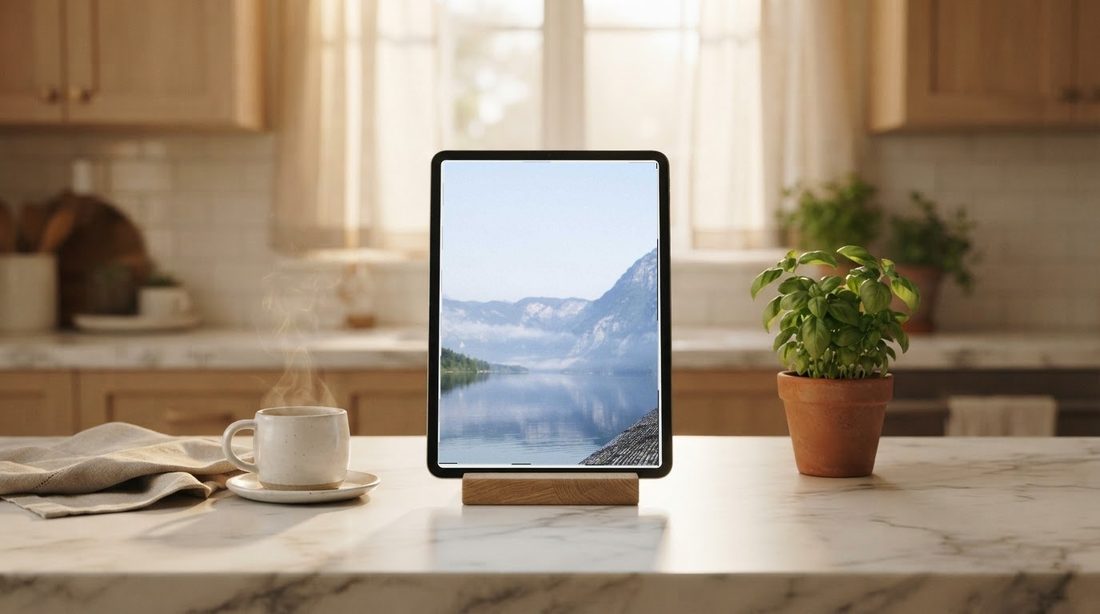
What PicDock does
Precisely, for our own app:
- SMB2/3 via jcifs-ng. Works with Synology, QNAP and generic SMB shares; SMB1-only servers are not supported.
- Sub-folders — an option when you pick the share, off or on as you like.
- Checks for new photos every 15 minutes — more often than cloud sources (30 minutes to 2 hours), because listing a local share is cheap.
- If the NAS is unreachable, the list stays. An empty or partial response is treated as a temporary fault, never as a deletion. The frame keeps showing cached photos and retries.
- Videos from the NAS — supported, but off by default; you turn it on in settings.
- Cache size — 100 MB, 250 MB, 500 MB (default), 1 GB or unlimited, so an old tablet with little storage still works.
Other options
We are not the only option. nFolio, Pixette and PhotoFrame 2 also read from SMB shares and come up often in searches. They differ in how they handle sub-folders, refresh and offline behaviour, so check each against the four points above.
In short
"Supports NAS" on a store page is not enough. Check the four separately: SMB2/3, sub-folders, how often it refreshes, and what it does when the share is unreachable. The last one is invisible until it happens, and it is the difference between a frame that keeps going and one that goes blank.
Already chosen? Here is the step-by-step setup: connect an Android tablet to a Synology or QNAP share.
PicDock — a photo and video frame for Android that reads Synology, QNAP and any SMB share directly. Free to use, with an optional paid upgrade for extras.